When organisations grow, leaders tend to look for failure in the obvious places.
They review the strategy.
They assess the leadership team.
They examine performance, cost, and delivery.
All sensible.
But in many scaling organisations, the real breakdown begins earlier and deeper — not in the strategy itself, but in the assumptions the organisation no longer notices.
That is where scaling rot begins.
It starts when behaviours that once drove success harden into habits that no longer fit the size, complexity, or ambition of the business. What once felt fast becomes inconsistent. What once felt entrepreneurial becomes undisciplined. What once felt decisive becomes dependent on a handful of people.
At first, none of this appears in the strategy deck.
The strategy may still look coherent. The ambition may still be sound. The leadership rhetoric may still be strong.
But the organisation has already started to misread itself.
That is the danger.
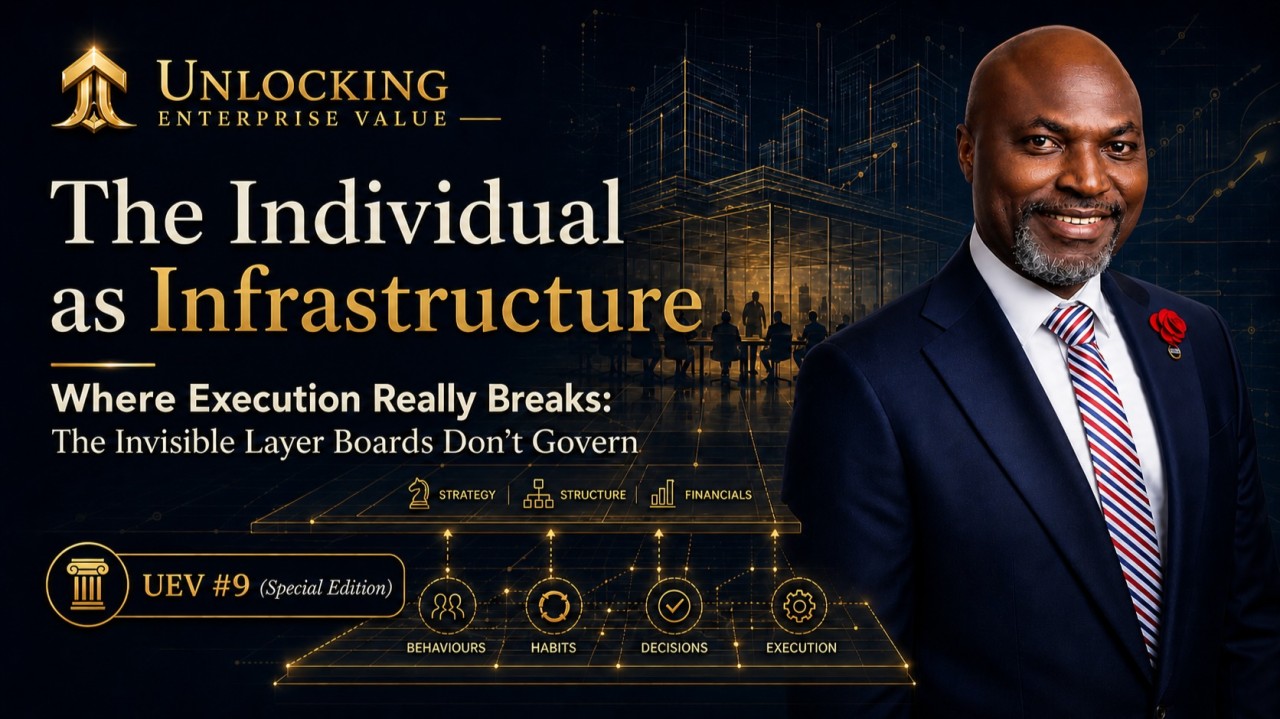
Because strategy does not travel through an organisation untouched. It is interpreted by culture, translated by leadership habits, and either reinforced or weakened by the way work actually gets done.
So the question for Boards is not only whether the strategy is right.
It is whether the organisation can carry it.
That is where many oversight conversations stay too close to the visible layer of the problem. Boards often see the strategic intent, the investment case, the transformation milestones, the operating updates. What they see less clearly are the unwritten rules shaping execution underneath them.
And that is often where value begins to leak.
You see it when decisions slow because authority has not scaled.
You see it when cross-functional friction rises because responsibilities remain blurred.
You see it when senior leaders become escalation points for issues the system should be handling without them.
You see it when local habits overpower enterprise discipline.
You see it when management reports suggest progress, but the organisation feels heavier, slower, and harder to align.
None of this looks dramatic at first.
That is precisely why it survives.
Most organisational decay is not sudden. It is normalised. It becomes the accepted cost of growth. People describe it as complexity, pace, or simply the price of becoming a larger business.
Often it is none of those things.
Often it is a sign that the organisation has scaled activity faster than it has scaled design.
That distinction matters.
Growth does not automatically produce maturity. In fact, scale tends to amplify whatever has gone unchallenged. If decision rights are unclear, scale increases confusion. If accountability is personal rather than systemic, scale produces bottlenecks. If leaders still rely on proximity, intervention, and individual rescue, scale turns strong executives into structural constraints.

This is why leadership itself has to change shape as the organisation grows.
Many leaders are promoted because they are effective in what I would call retail leadership. They lead through judgement, presence, responsiveness, and direct influence. They stay close to the work. They solve problems quickly. They are trusted because they are visible.
That can be highly effective in earlier-stage environments.
But scale requires something different: wholesale leadership.
Wholesale leadership is less about personal reach and more about organisational architecture. It is the ability to build clarity that travels. To create decision rights that do not depend on constant escalation. To shape incentives, routines, and expectations that hold across the enterprise. To build leadership beneath you rather than centrality around you.
In other words, the task shifts from being the person who makes things happen to being the person who makes it possible for things to happen well without you.
That is a far more demanding test of leadership.
And it is where many otherwise capable executives start to struggle — not because they lack intelligence or commitment, but because the behaviours that made them successful are now being mistaken for the behaviours the organisation still needs.
Boards should pay close attention to that shift.
Because in a scaling business, leadership capability is not just about calibre. It is about fit. The issue is not whether executives are strong. It is whether their way of leading still matches the operating demands of the enterprise they now serve.
That leads to a harder question — one Boards should ask more often.
Not: Is the strategy clear?
But:
What in this organisation still belongs to an earlier stage of growth?
Which assumptions still govern decision-making? Where does performance still rely on heroic effort? Which behaviours are still being rewarded even though they no longer serve the strategy? Where is the organisation mistaking familiarity for fitness?
Those are not soft questions.
They are value questions.
Because once scaling rot sets in, the cost is not cultural in some abstract sense. It shows up in slower execution, duplicated effort, management drag, weaker accountability, inconsistent customer outcomes, and poorer returns on strategic investment.
By the time the strategy visibly falters, the organisation has often been under strain for some time.
That is why the first job is not to rewrite the strategy.
It is to examine the system carrying it.
The strongest organisations do not assume growth will modernise them. They understand that scale is a stress test. It exposes where leadership has not evolved, where culture has gone unchallenged, and where the operating model still reflects a smaller version of the business.
That is the real lesson.
In scaling organisations, strategy rarely fails alone. It weakens in the culture beneath it, in the leadership habits around it, and in the assumptions no one is still questioning.
If those things are not redesigned as the business grows, the organisation does not become more capable.
It simply becomes larger, slower, and more expensive to move.
Selected references
- McKinsey has repeatedly noted how difficult enterprise transformation is, often citing failure rates around 70% and highlighting capability building and engagement as key factors in success.
- McKinsey’s State of Organizations 2023 also points to persistent capability gaps and organisational unpreparedness in the face of external shocks.
- Gallup reported that low employee engagement cost the global economy US$8.9 trillion and that global employee engagement in 2023 remained at 23%.