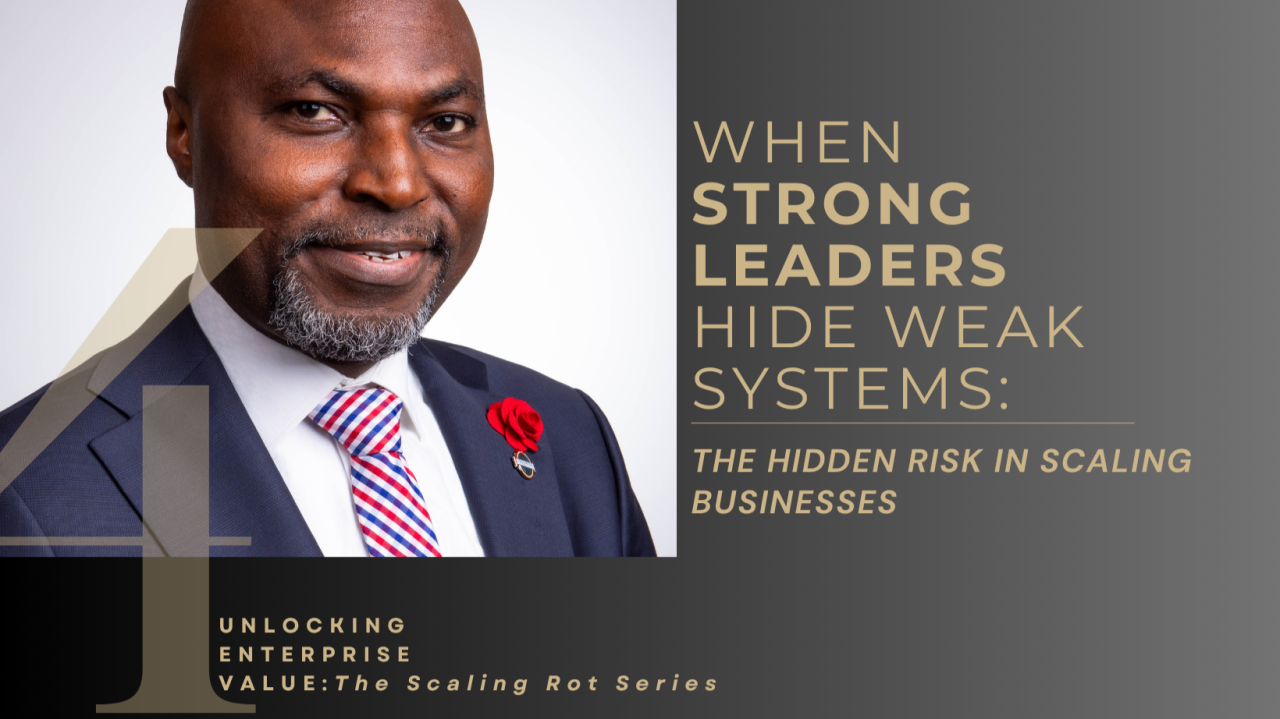
One of the more dangerous illusions in a scaling organisation is this:
Performance continues, so leaders assume the system is sound.
The numbers hold. Priorities move. Strong executives stay close. Problems get solved.
But that is precisely where risk can hide.
Sometimes the business is not being carried by a robust system. It is being held together by a few highly capable people, compensating for what the system itself cannot do reliably.
That is not resilience.
It is dependency.
And dependency is one of the earliest signs that growth may be outpacing design.
When Strength Becomes Camouflage
Strong leaders can conceal weak systems for longer than most Boards realise.
They absorb complexity.
They unblock decisions.
They connect fractured priorities.
They keep momentum alive where the system cannot.
From the outside, this looks like leadership excellence.
Inside the organisation, it can mean something else entirely: personal capability is compensating for structural weakness.
That distinction matters.
Because if performance depends too heavily on intervention, escalation, and personal authority, the enterprise is drawing reliability from people where it should be drawing reliability from design.
Heroics are not proof of health. They are often evidence of design debt.
The Point Boards Should Test
The question is not whether there are strong leaders in the business.
Most organisations can point to several.
The more useful question is this:
Are those leaders strengthening the enterprise — or quietly compensating for weaknesses it should no longer have?
That is where scale integrity begins to matter.
An organisation with integrity at scale does not require exceptional people to keep basic coordination, accountability, and decision-making intact. It may still have exceptional leaders, of course. But their strength builds capability. It does not merely hold fragility together.
That is the difference between leadership that strengthens the system and leadership that substitutes for it.
How Dependency Shows Up
The pattern is usually visible before it is named.
Decision-making slows because too much still flows through too few people.
Cross-functional friction rises because accountability is blurred.
Strategic work loses pace because senior leaders spend more time stitching the organisation together than building the next layer of capability.
By then, the business is no longer benefiting from strong leadership alone.
It is becoming dependent on leadership heroics.
And heroics do not scale.
This is one of the most difficult truths for executive teams to confront, because dependency often forms around highly respected people. The individuals at the centre of it are usually some of the organisation’s strongest contributors. They are trusted because they are capable.
But the stronger the individual, the easier it becomes to misread the weakness of the surrounding system.
A leader who rescues the system every week may, in effect, have become the system.

What The Wider Evidence Suggests
The broader research points in the same direction: organisations do not struggle only because strategy is weak. They often struggle because the capability, engagement, and operating conditions required to carry the strategy through the enterprise are not strong enough.
McKinsey has repeatedly stated that roughly 70% of transformations fail, pointing to factors such as weak organisational engagement and insufficient investment in capability building.
Harvard Business Review, summarising a meta-analysis of 128 global companies, reported that only 22% were successful in their transformation efforts.
McKinsey’s State of Organisations 2023 also found that only half of the surveyed leaders believed their organisations were well prepared to anticipate and respond to external shocks, while two-thirds viewed them as overly complex and inefficient.
None of that proves that leadership dependence is always the cause. But it does reinforce a harder truth: organisational capability, not strategic intent alone, is often where performance holds or breaks.
The Governance Issue Beneath The Leadership Issue
This is why Boards should pay close attention to where performance appears concentrated.
Not because strong leaders are a problem, but because they can become an unintended substitute for organisational design.
A useful Board question is this:
If this leader stepped back, what would still work well — and what would begin to wobble immediately?
That question often reveals more about scalability than a dashboard alone.
Where organisations become too person-dependent, several risks accumulate at once:
• Execution risk — because progress relies on intervention rather than operating rhythm
• Leadership risk — because succession is more fragile than it appears
• Strategic risk — because current delivery is mistaken for genuine scalability
• Economic risk — because delay, rework, management drag, and slower enterprise response begin to erode value
This is not a cultural observation in the soft sense.
It is a structural one.
If performance needs rescuing, performance has not yet been designed.
From Heroic Leadership To Scalable Architecture
The most effective Boards do more than assess leadership calibre. They examine organisational dependency.
They ask where strong executives are carrying too much of the enterprise personally.
They test whether decision rights are embedded or merely understood by a few trusted individuals.
They look for signs that leadership strength is compensating for weak architecture rather than reinforcing sound design.
In other words, they test whether performance is being produced by capability — or by rescue.
That is a more demanding level of oversight.
It moves the conversation beyond Do we have strong leaders? and into the more consequential territory of Have we built an organisation that can perform without excessive dependence on exceptional individuals?
That is not a soft question.
It is a strategic one.
Because organisations that scale well do not rely indefinitely on talented people holding the centre.
They use those people to build a business in which the centre holds more reliably.
Scale Should Reduce Unnecessary Dependence, Not Multiply It.
And when it does not, leadership strength can become one of the reasons structural weakness stays hidden for too long.
By the time the weakness becomes visible in execution failure, the cost of redesign is usually far higher.
Three questions for Boards and C-level leaders
1. Where is current performance relying more on individual intervention than on embedded organisational capability?
2. Which leaders are strengthening the system — and which are quietly compensating for weaknesses it should no longer have?
3. If scale, complexity, or pace increased materially, where would the business depend on heroics rather than architecture?
BOTTOM-LINE: An organisation is not truly strong when exceptional leaders keep it moving. It is strong when it can move well without asking exceptional people to carry what the system itself should hold.
This article is an original commentary, informed by broader published research on transformation failure, organisational capability, and leadership adaptation, particularly from McKinsey and Harvard Business Review. Specific source-based observations are acknowledged in the body of the article where directly relevant.
Selected references for further reading
• McKinsey & Company — Perspectives on transformation: McKinsey states that 70% of transformations fail and points to weak engagement and insufficient capability building as common contributors.
• Harvard Business Review — The Secret Behind Successful Corporate Transformations: HBR summarises a meta-analysis of 128 global companies and reports that only 22% were successful in their transformation efforts.
• McKinsey & Company — The State of Organisations 2023: McKinsey reports that only half of surveyed leaders felt well prepared for external shocks and that two-thirds viewed their organisations as overly complex and inefficient.