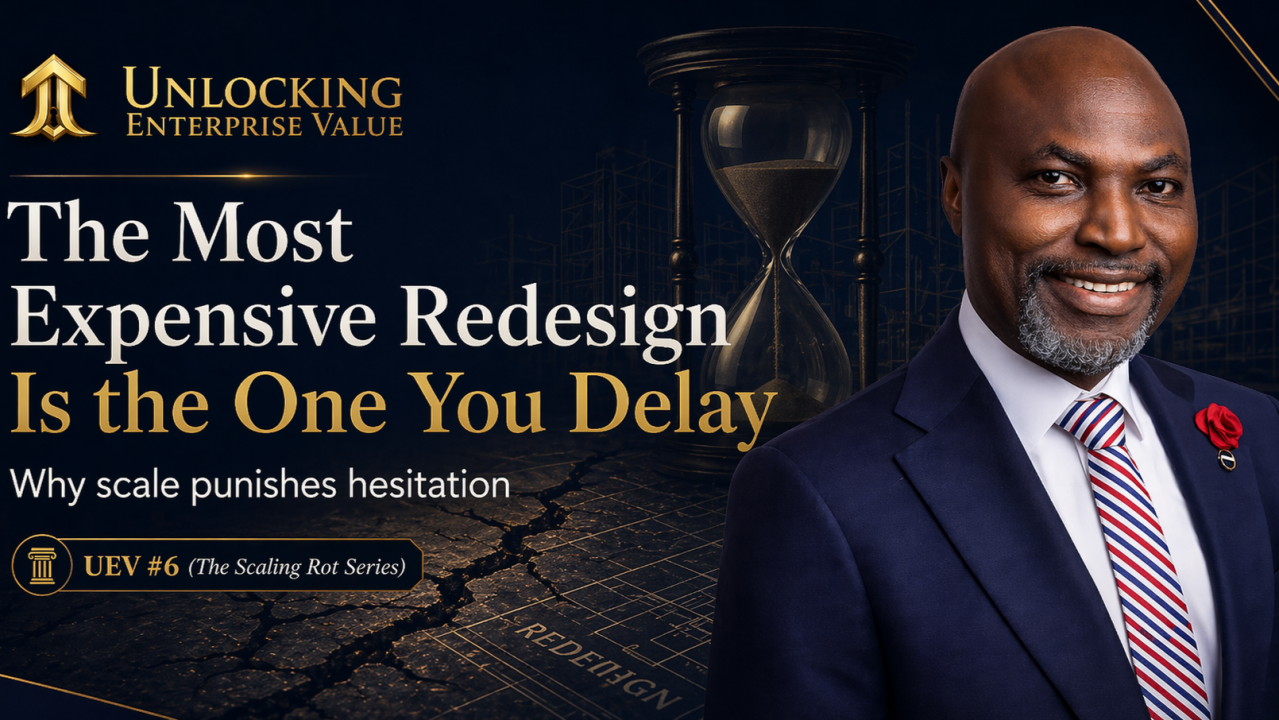
When scale outgrows structure, waiting does not preserve value—it erodes it.
When organisational design no longer matches strategic ambition, the instinct is often to wait. To stabilise first. To avoid further disruption. To rely on strong leaders and incremental fixes until the pressure eases.
That instinct is understandable.
It is also expensive.
Because when scale has outgrown structure, delay does not preserve value. It quietly erodes it.
Not always through sudden failure, but through slower decisions, diluted accountability, rising coordination costs, repeated rework, and growing reliance on managerial intervention just to sustain momentum.
By the time Boards agree that redesign can no longer wait, much of the cost has already been incurred.
Why delay feels safer than it is: Boards rarely delay redesign because they are complacent. More often, they delay because the organisation is still performing “well enough”.
Targets may still be met. Risks appear manageable. Leaders are stretched, but coping. Major disruptions feel risky when confidence is fragile.
The problem is that organisational misfit does not behave like a technical defect. It behaves like structural drag.
The business continues to move, but it does so with increasing effort and diminishing returns.
McKinsey’s long‑running transformation research shows that most value loss in large change programs does not occur at the point of visible failure, but accumulates earlier through slow execution, unclear decision rights, and capability gaps that make change harder and more costly to deliver (McKinsey, 2019; McKinsey, 2021).
Delay compounds that effect.
What delayed redesign actually cost: When redesign is postponed, cost tends to show up in four places that rarely appear together on a single dashboard.
First, decision latency increases. Issues that should be resolved close to the work escalate upward, slowing response and tying senior leaders into operational arbitration. Over time, speed becomes a leadership constraint rather than a system attribute (McKinsey, 2022).
Second, management overhead grows. Coordination replaces clarity. Meetings proliferate to compensate for blurred accountability. Senior leaders spend more time stitching the organisation together than building the next layer of capability.
Third, execution quality degrades. Strategic initiatives consume more effort to deliver the same outcome. Rework becomes normalised. Dependencies multiply. The organisation absorbs friction rather than removing it.
Finally, enterprise optionality declines. The capacity to absorb further growth, integrate acquisitions, adopt new operating models, or pivot strategy weakens. What looked like prudence becomes rigidity.
Harvard Business Review’s analysis of corporate transformations found that even where outcomes appear positive, many organisations capture only a fraction of the potential value they set out to achieve, largely because the operating system beneath the strategy was not rewired early enough (Argenti et al., 2021).
Why cost is often underestimated at Board level: The cost of delayed redesign is subtle because it rarely arrives as a line item.
It appears as:
- slower time to value
- higher execution risk
- declining returns on strategic investment
- leadership fatigue
- reduced resilience when shocks arrive
McKinsey’s State of Organisations research shows that two‑thirds of leaders already view their organisations as overly complex and inefficient, while only half believe they are well prepared to absorb future disruption (McKinsey, 2023).
In that context, delay does not maintain stability. It increases exposure.
The longer structural weakness persists, the more redesign becomes disruptive rather than enabling, expensive rather than corrective.
What strong Boards do differently: Boards that manage this well do not wait for strategy to fail before asking whether structure still fits.
They treat organisational design as a value‑at‑risk issue, not an internal hygiene matter.
They ask whether rising management effort is masking declining system effectiveness. They pay attention to where cost, delay, and friction are increasing even as performance appears stable. And they recognise that postponing redesign often shifts cost from visible disruption to invisible erosion.
Redesign done early feels bold. Redesign done late feels painful. But redesign avoided is usually the most expensive option of all.
Structural debt, like financial debt, compounds quietly—until it limits strategic freedom.
Three questions for Boards and C‑level leaders
- Where is organisational effort increasing faster than enterprise output?
- What strategic initiatives now cost more time, energy, or leadership attention than they should?
- If redesign were delayed another 12–18 months, what options would quietly close?
Selected references for further reading
- Argenti, P. A., Berman, J., Calsbeek, R., & Whitehouse, A. (2021). The Secret Behind Successful Corporate Transformations. Harvard Business Review.
- McKinsey & Company. (2019). Why do most transformations fail?
- McKinsey & Company. (2021). Losing from day one: Why even successful transformations fall short.
- McKinsey & Company. (2022). Common pitfalls in transformations.
- McKinsey & Company. (2023). The State of Organisations 2023.