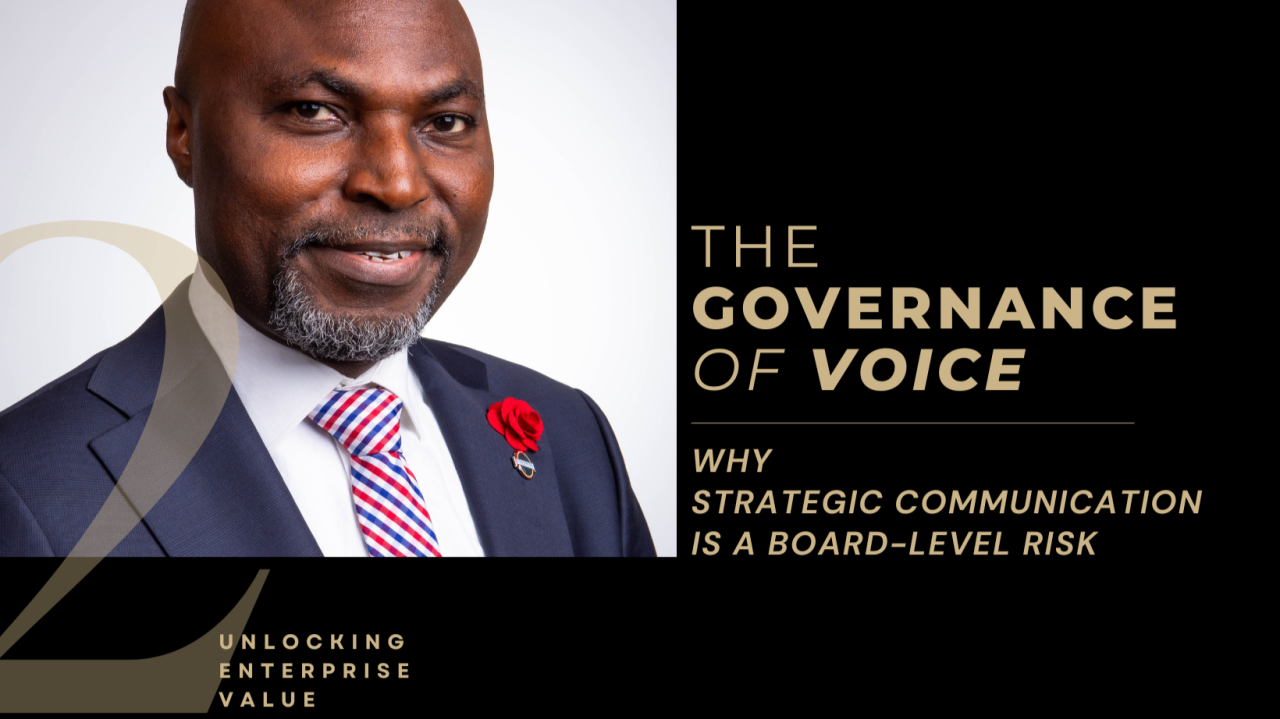
In the hierarchy of corporate risks—cybersecurity, market volatility, regulatory compliance—there is one critical vulnerability that rarely makes the official register: The Governance of Voice.
Most Boards and C-level executives treat communication as a ‘soft skill,’ a secondary function relegated to middle management. This is a strategic error. In a globalised, high-stakes business environment, communication is the Strategic Infrastructure that determines whether a boardroom vision lives or dies in execution.
The Execution Gap: A Translation Failure -The most expensive distance in any organisation is the gap between the Board’s strategic intent and the front line’s operational execution. Research by the Project Management Institute (PMI) found that for every $1 billion spent on projects, $135 million is at risk—and 56% of that risk ($75 million) is due to ineffective communication [PMI, 2013].
When the C-suite fails to architect a clear ‘Voice,’ strategic intent is lost in translation. For a multi-billion-pound operation, this misalignment isn’t just frustrating—it is a measurable erosion of shareholder value.
Voice as a Fiduciary Duty: Scaling the Message -My experience serving on diverse boards working with organisations at scale, over the years, has confirmed that: Governance is not just about oversight; it is about Mission Alignment.
When a Board approves a strategy, they have a fiduciary duty to ensure that the strategy is communicated with such clarity that it can be executed across diverse territories without dilution. Research from MIT Sloan indicates that only 28% of executives and middle managers responsible for executing strategy can list even three of their company’s strategic priorities [MIT Sloan, 2018].

The Risk of Silence: Psychological Safety as Risk Management -The most dangerous ‘Voice’ risk is the one that is never heard. High-performance cultures are built on Psychological Safety. Edelman’s 2024 research shows a pronounced transparency and trust gap at work: executives (EVP+) are 2.5× more likely than associates to trust their CEO to tell the truth about what’s happening within their organisation [Edelman, 2024]. From a governance perspective, a lack of psychological safety is a Risk Management failure.
The Architect’s Questions for the Board and C-suite
- The Integrity Test: Does our front-line staff’s understanding of our strategy match the Board’s original intent?
- The Information Pipeline: Are we hearing the ‘hard truths’ from the operational level, or is our information being filtered?
- The Global Clarity Metric: If we shifted our global mission today, how long would it take for 100% of our workforce to speak the language of our new strategy?
The Bottom Line: ‘Voice’ is the nervous system of the organisation. Boards and C-suite leaders must stop viewing communication as ‘talking’ and start viewing it as the Governance of Strategic Intent.
Selected References for the Board & C-Suite
- Project Management Institute (2013). The Essential Role of Communications: The High Cost of Low Performance (Pulse of the Profession In-Depth Report). Project Management Institute.
- Sull, D., Sull, C., & Yoder, J. (2018). ‘No One Knows Your Strategy — Not Even Your Top Leaders.’ MIT Sloan Management Review.
- Edelman (2024). 2024 Edelman Trust Barometer Global Report. Edelman Trust Institute.
- Edelman (2024). Special Report: Trust at Work. Edelman Trust Institute. (Finding cited: Executives (EVP+) are 2.5× more likely than associates to trust their CEO to tell the truth.)