
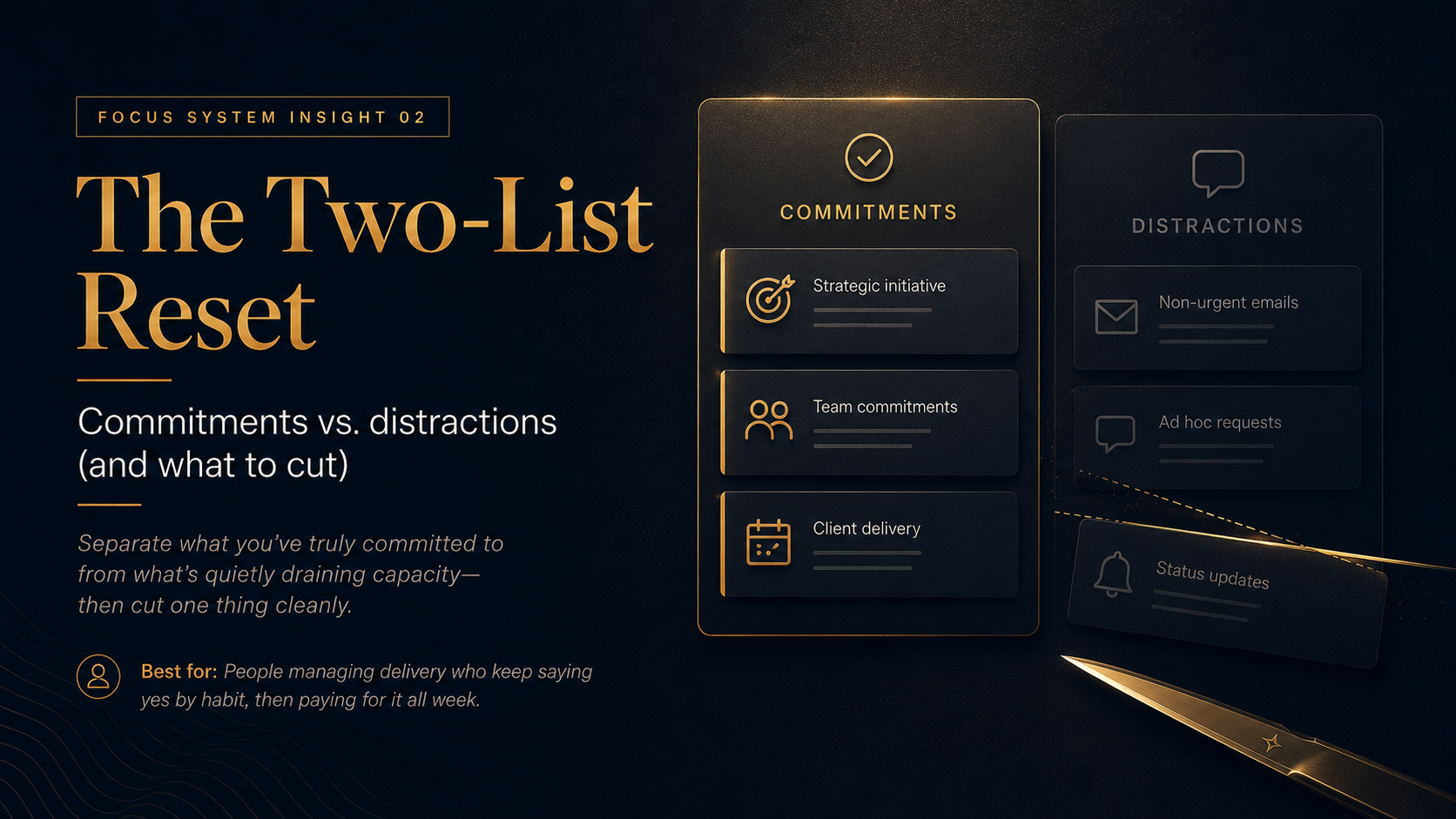
Separate what you’ve truly committed to from what’s quietly draining capacity—then cut one thing cleanly.
Best for: People managing delivery who keep saying yes by habit, then paying for it all week.
1) The Situation
You’re not disorganised. You’re over-committed.
Your week is a pile of “small” agreements: quick reviews, check-ins, favours, extra visibility updates.
Each one feels harmless.
Together, they leave no space for real work—and no clean way to explain why.
2) Line to Consider
Most overload isn’t caused by one big thing.
It’s caused by ten small things you never re-negotiated.
3) The Model — Commitment vs. Drift
There are two kinds of work in your week:
- Commitments: explicit promises, owned outcomes, real deadlines.
- Drift: work you inherited, work you tolerate, work you do “just in case”.
Drift isn’t evil. It’s just unclaimed.
The Two-List Reset makes drift visible—and therefore removable.
4) The Tool — Two-List Reset (worksheet)
A fast worksheet to separate the week into two lists—and decide one cut.
Use it in under 10 minutes:
- List A: Commitments (3 minutes)
Write what you are genuinely on the hook for (deliverables, approvals, decisions, people responsibilities). - List B: Distractions (3 minutes)
Write everything else that steals time or attention (standing meetings, “FYI” tasks, duplicate reporting, vague asks). - Tag each distraction with a cut type (3 minutes):
- Delete: stop doing it.
- Defer: not this week.
- Delegate: someone else owns it.
- Downgrade: reduce quality/effort (e.g., “2 bullets instead of a slide deck”).
- Choose one cut and write the sentence you’ll use to communicate it (1 minute).
Related: If you haven’t chosen a Weekly Priority yet, start with Insight 01 — The Priority Filter.
5) The Move — Cut One Thing Cleanly (within 7 days)
Cutting isn’t a private intention. It’s a communication act.
Steps:
- Run the Two-List Reset. Identify one drift item you will cut.
- Choose the cut type (delete/defer/delegate/downgrade).
- Communicate it to the relevant person within 24 hours using the script below.
- If they push back, ask for a trade: “Which commitment should I drop to make room?”
- Record the decision somewhere visible (your notes, a team tracker, a short message).
6) Manager Script
“I can do X, but not alongside Y this week. Which one matters more to you?”
7) Common Failure Mode
Failure: You “cut” by going quiet—hoping no one notices.
That creates anxiety and damages trust.
Correction: Cut explicitly, with a trade-off and a next checkpoint:
- “Not this week; I’ll revisit on Tuesday.”
- “I’m downgrading to a short note, not a deck.”
- “I’m handing this to Sam; I’ll stay available for questions.”
Clean cuts reduce drama because they reduce guessing.
- Reply prompt: What’s one “small” weekly commitment that quietly costs you the most?
- Service bridge: If you want to redesign your team’s workload so priorities hold without burnout, I run coaching and delivery clarity sessions.