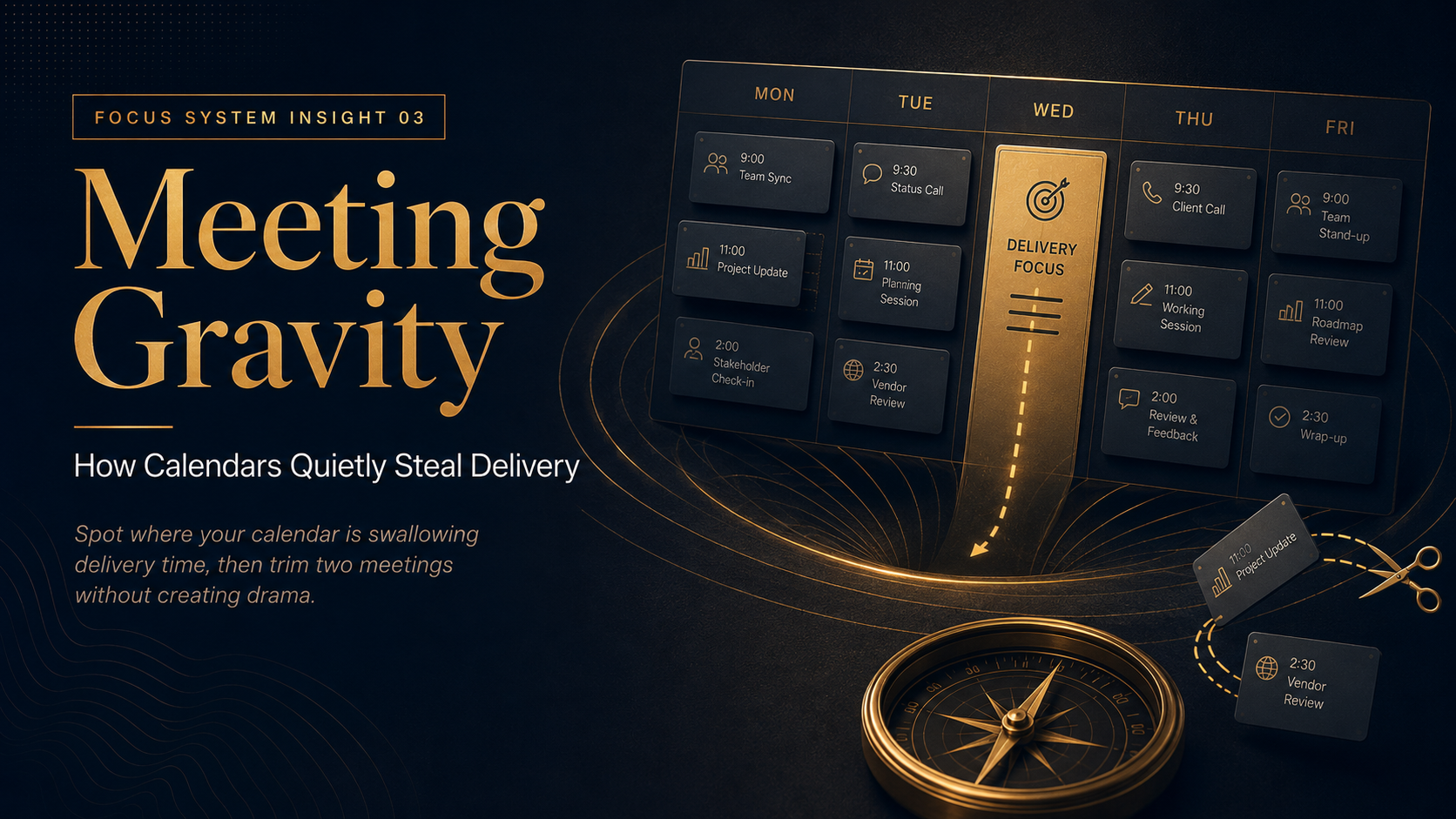
Meeting Gravity: How Calendars Quietly Steal Delivery
Spot where your calendar is swallowing delivery time, then trim two meetings without creating drama.Best for:
Line managers and professionals whose week feels full but strangely light on actual progress1) The SituationMost people do not notice meeting overload because it rarely arrives as one obvious problem.It arrives as:
The issue is not that meetings exist.
The issue is that many calendars are built around attendance, not delivery.
So the week fills with fragments. You move all day, but the work that actually requires thought, judgement, writing, planning, or decision-making gets pushed into the edges.
That is not poor discipline. It is structural drag.
2) Line to Consider
A crowded calendar does not prove importance. It often proves a lack of design.
3) The Model — Meeting Gravity
Meeting Gravity is the quiet pull your calendar exerts on the rest of your week.
The more gravitational pull the calendar has, the harder it becomes to:
- start meaningful work
- think clearly for long enough to finish something
- make decisions before they become urgent
- protect priorities from interruption
- keep promises without working around the edges of the day
Meeting Gravity usually comes from four sources:
- Legacy meetings
Meetings that continue because they always have.
- Visibility meetings
Meetings designed to reassure people rather than move work.
- Unclear-owner meetings
Meetings where attendance replaces responsibility.
- Insurance meetings
Meetings people keep “just in case”, because clarity is weak elsewhere.
None of these are automatically wrong.
But if the calendar is not regularly reviewed, they become normal. Then normal becomes heavy, and heavy becomes expensive.
4) The Tool — Meeting Gravity Audit (checklist)
A one-page checklist to identify where meetings are consuming disproportionate value.
Use it in under 10 minutes.
Step 1: List your recurring meetings for the next 2 weeksInclude:
Step 2: Mark each meeting against 4 questions
For each one, ask:
- What decision, movement, or clarity does this create?
- Would anything break if this was 15 minutes shorter?
- Does everyone attending need to be there for the whole meeting?
- Could this be replaced by a short note, decision memo, or asynchronous update?
Step 3: Tag each meeting
Choose one tag:
- Keep — clearly useful as currently designed
- Trim — shorten it
- Reduce — attend less often
- Replace — convert to written update or lighter rhythm
- Exit — stop attending
Step 4: Choose two changes only
Do not redesign your entire calendar in one burst. Pick two trims you can make this week with minimal drama and clear reasoning.
Link: [Download Meeting Gravity Audit]
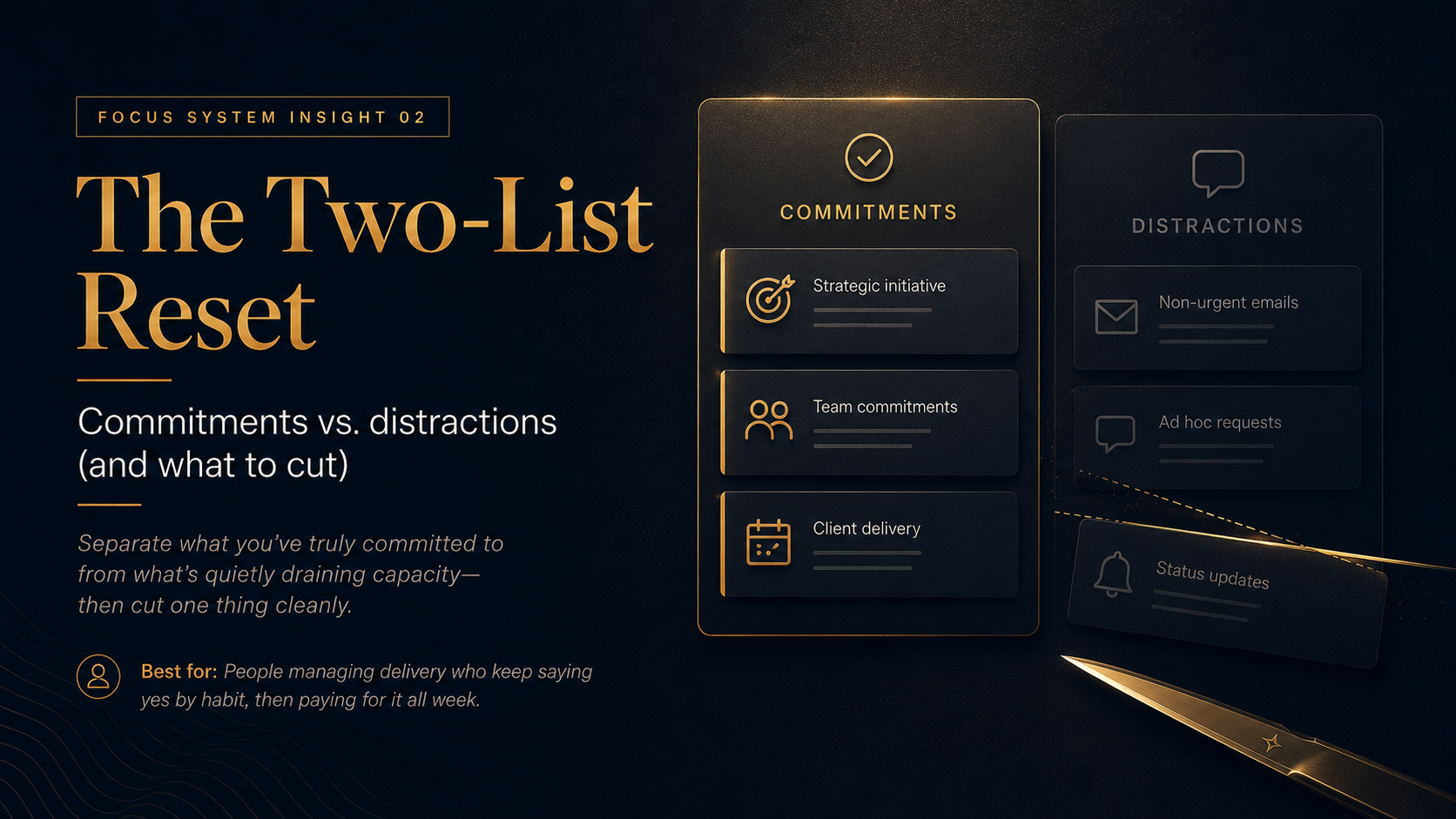
Related: If your week still lacks focus even after cutting distractions, revisit The Two-List Reset and identify what drift still appears in calendar form.
Next: Use The Focus Block Standard to protect the time you recover.
5) The Move — Trim Two Meetings (within 7 days)
The goal is not to become unavailable.
The goal is to reduce low-yield attendance so delivery has a fair chance.
Within the next 7 days:
If nothing broke, the meeting was probably heavier than it was useful.
6) Manager Script
“I want to protect delivery time more deliberately this month. I’m trimming a few meetings that no longer need the current level of attendance. For this one, I suggest we shorten it to 15 minutes / move to written updates / have me attend fortnightly unless a decision is needed.”
If challenged:
“Happy to stay involved where it changes the outcome. If you want me in this in full, which piece of delivery should move to make space?”
7) Common Failure Mode
Failure:
You keep every meeting, but tell yourself you will “just be more disciplined”.
That almost never works. You are trying to solve a structural problem with personal effort.
Correction:
Redesign the calendar, not just your intentions.
A better pattern is:
- cut or reduce one recurring meeting
- shorten one more
- convert one update into writing
- protect the recovered space immediately
If you do not actively claim the time back, the calendar will reclaim it.
Reply Prompt
Which recurring meeting adds the least value to your actual delivery right now?
If you want to redesign how your team uses meetings, priorities, and decision rhythms so work moves without constant overload, I run coaching and delivery clarity sessions built for real operating environments. [Work with Patrick]